The Chip War: How Semiconductors Became the Battleground of Great-Power Rivalry
Export controls, vast subsidy races and a scramble to secure the most advanced chips have made semiconductors the central front of great-power competition — and a technology most people never think about into the prize that could decide the balance of power.
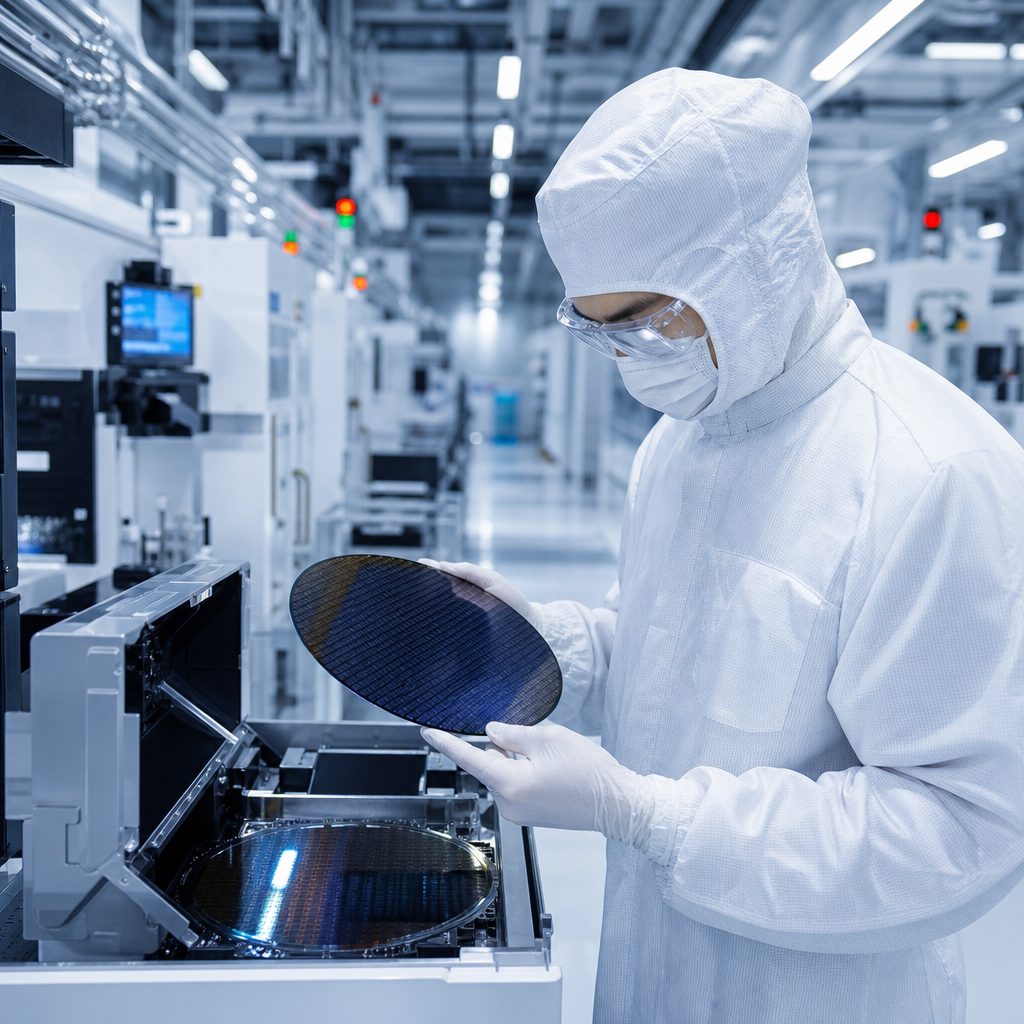
A single silicon wafer holds hundreds of chips — and, increasingly, the strategic ambitions of the world's most powerful states.
The most fought-over commodity of the current era is not oil, gold or grain. It is a sliver of silicon smaller than a fingernail, etched with billions of transistors so tiny they are measured in atoms. Advanced semiconductors — the chips that power everything from smartphones and cars to artificial intelligence and precision weapons — have become the single most contested technology in the world. The competition to design them, manufacture them and control access to them has grown into a full-scale strategic contest, often called the "chip war," and its outcome will help shape the balance of power for decades.
The reason is straightforward once stated. Modern economic and military strength rests increasingly on computing power, and computing power rests on chips. Whoever controls the most advanced semiconductors controls a foundational input to nearly every technology that matters, from the artificial intelligence systems reshaping industry to the guidance systems in advanced weapons. In an age defined by technology, chips are the commanding heights — and the great powers have recognised it.
An extraordinarily concentrated industry
What makes semiconductors such a potent arena for rivalry is the extreme concentration of the industry. Unlike oil, which is pumped in dozens of countries, the most advanced chips can be manufactured in only a handful of places, using equipment that only a few companies in the world can build, drawing on materials and expertise that took decades to develop. Each link in this chain is a potential chokepoint — a place where control translates directly into leverage.
Consider the structure. The design of cutting-edge chips is dominated by a small number of firms. The manufacturing of the most advanced chips is concentrated overwhelmingly in a few facilities, many of them in one geographically exposed location. The ultra-precise machines needed to etch the smallest features are made by essentially a single company. And the specialised materials and gases required at every stage — including the strategic gases that recent export restrictions have thrust into the news — come from a limited set of suppliers. Control of any of these chokepoints confers enormous power, which is precisely why they have become the focus of statecraft.
Oil is pumped in dozens of countries. The world's most advanced chips can be made in only a handful of places — and that concentration is the whole game.
The weapon of export controls
The most powerful instrument in the chip war has been the export control. By restricting the sale of the most advanced chips, and crucially the equipment and software needed to make them, a state that dominates key chokepoints can deny a rival access to the frontier of the technology. The aim is to slow a competitor's progress in strategically sensitive fields, above all artificial intelligence and advanced weapons, by starving it of the computing power those fields require.
These controls have reshaped the industry. They have forced companies to redesign products, split their operations along geopolitical lines, and navigate an ever-thickening web of rules about what can be sold to whom. They have also triggered a determined push by the targeted states to build their own capabilities and reduce dependence on foreign suppliers — a reminder that leverage, once used, tends to accelerate the search for alternatives. The reported curbs on strategic materials such as helium are best understood as a countermove in this same contest: if one side can restrict chips, the other can restrict the inputs chips require.
The subsidy race
Alongside restriction has come construction. Recognising the strategic risk of depending on distant or concentrated supply, governments across the world have launched vast programmes to build semiconductor manufacturing at home. Enormous sums of public money are being poured into new fabrication plants, research and workforce development, in a global subsidy race without recent precedent. The goal is resilience: to ensure that a disruption in one location — whether from conflict, natural disaster or political pressure — cannot cripple a nation's access to the chips it needs.
The logic is sound, but the economics are daunting. Building advanced chip factories is staggeringly expensive, technically forbidding and slow; a single leading-edge facility can cost tens of billions and take years to reach full production. Duplicating capacity in multiple locations for the sake of security means accepting higher costs and lower efficiency than a purely market-driven industry would tolerate. It is, in effect, a global insurance premium against strategic vulnerability — one more instance of the broad shift from optimising for efficiency to optimising for resilience.
The Taiwan factor
Looming over the entire chip war is a single geographic reality: the concentration of the world's most advanced manufacturing in Taiwan, an island at the centre of one of the planet's most dangerous flashpoints. This concentration is the ultimate source of the industry's fragility, and it is why the security of the Taiwan Strait is inseparable from the security of the global technology economy. A conflict there would not merely be a regional tragedy; it would sever the world's supply of its most critical component. Every subsidy programme and every effort to diversify is, in part, an attempt to reduce this dependence — but it cannot be eliminated for years.
Every new chip factory and every export control is, at bottom, a hedge against a single terrifying possibility: that the world's supply of advanced chips could be cut off.
Why it matters to everyone
It would be easy to dismiss the chip war as a specialist concern, a struggle among governments and corporations over an obscure technology. That would be a mistake. The outcome will influence which nations lead in artificial intelligence and advanced industry, and therefore the future distribution of economic and military power. It will shape the price and availability of the electronic devices woven through daily life. And it will determine how resilient the world is to the next disruption in a supply chain that underpins virtually everything.
The chip war captures, in concentrated form, the defining dynamic of the age: the collision of economic interdependence with strategic rivalry. For decades, the semiconductor industry was a triumph of globalisation, with each stage of production located wherever it could be done best and cheapest. That model delivered astonishing progress at low cost — but it also created dependencies that, in a more contested world, look less like efficiency and more like vulnerability. Untangling them will be expensive, slow and fraught. But the great powers have decided that control of the world's most advanced chips is worth the price, and that decision is reshaping the global economy one fabrication plant at a time.