A Year of Elections: Why 2026's Votes Are Testing Democracy to Its Limits
Polarised electorates, industrial-scale disinformation and margins thin enough to contest are turning this year's ballots into a global stress test for the machinery of self-government.
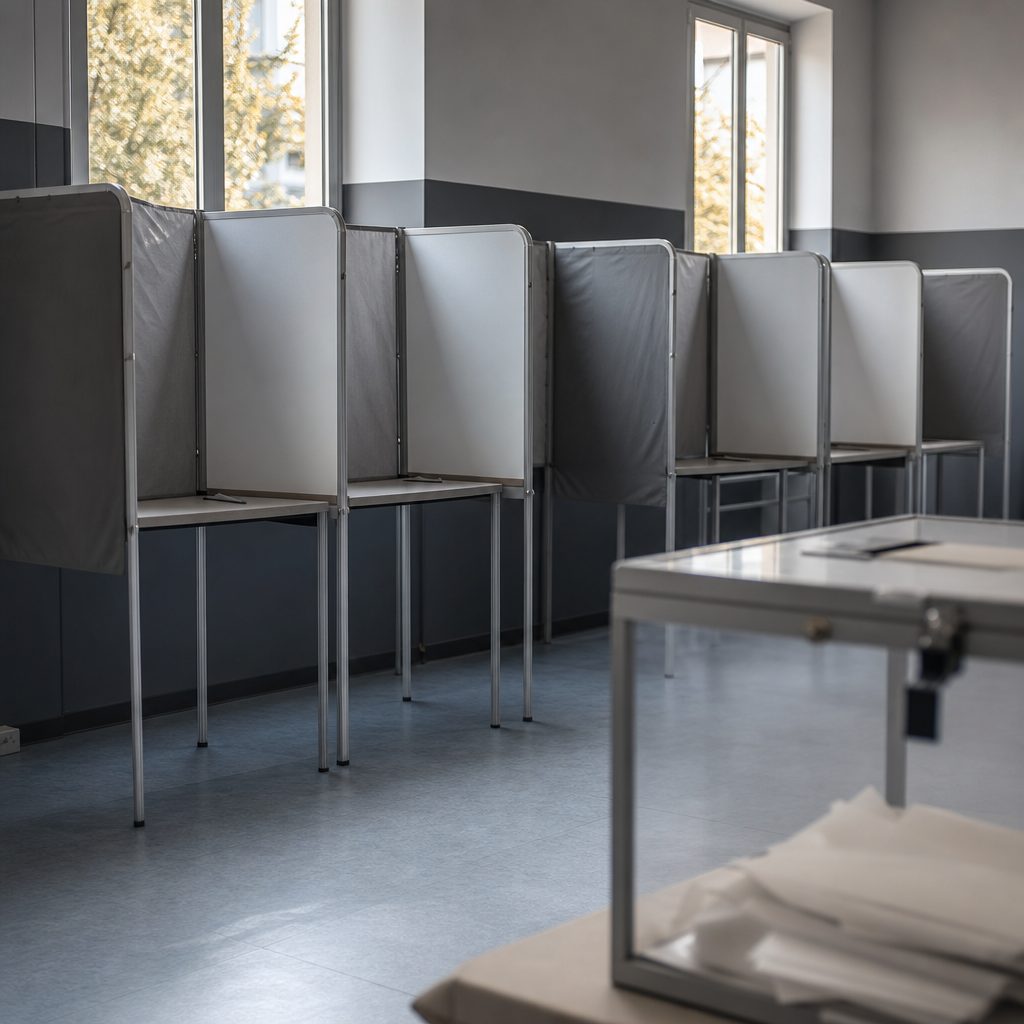
The quiet infrastructure of democracy: booths, ballots and the fragile trust that binds them together.
An election, at its core, is a remarkably simple idea: citizens cast votes, the votes are counted, and the losers accept the result. That simplicity conceals an enormous amount of trust — trust that the count is honest, that the rules are fair, that the losing side will hand over power peacefully and live to contest another day. It is this trust, more than any particular policy or personality, that is being tested by the wave of elections shaping 2026. Around the world, the machinery of self-government is holding, but it is straining, and the strains are worth examining honestly.
The pressures are not identical everywhere, and it would be a mistake to flatten very different countries into a single narrative of decline. Democracy is not collapsing; in many places it is proving surprisingly durable. But a common set of stresses recurs across otherwise dissimilar contexts, and taken together they describe a challenging moment for the idea that citizens should choose their own leaders through free and fair competition.
Polarisation and the shrinking centre
The first and most pervasive strain is polarisation. In many democracies, the electorate has sorted itself into camps that increasingly distrust and dislike one another, viewing political opponents not as fellow citizens with different views but as threats to be defeated. When politics becomes this tribal, the ordinary business of compromise — the give-and-take that allows diverse societies to govern themselves — becomes far harder. Elections stop being contests over policy and become existential struggles, raising the stakes and lowering the willingness to accept defeat gracefully.
This polarisation feeds a corrosive dynamic. As each side comes to see the other's victory as intolerable, the temptation grows to question the legitimacy of unfavourable results, to bend the rules while in power, and to treat institutions as instruments of factional advantage rather than shared inheritance. None of this need be dramatic; it often takes the form of small erosions rather than sudden ruptures. But the cumulative effect is to weaken the norms of restraint on which democratic competition depends.
Democracy runs on a single unwritten agreement: that the losers accept the result. Everything else is machinery. That agreement is what is being tested.
The information problem
The second major strain concerns information. Free elections require an informed public, and the information environment has become extraordinarily contested. Disinformation now spreads at industrial scale and speed, amplified by platforms optimised for engagement rather than accuracy. Increasingly sophisticated fabrication — including convincing synthetic images, audio and video — makes it harder for citizens to know what is real, and easier for bad actors to sow confusion and distrust.
The danger is not only that voters may be deceived by specific falsehoods, corrosive as that is. It is the more general erosion of a shared factual baseline. When citizens cannot agree on basic facts — what a candidate said, what actually happened, whether a result is legitimate — the common ground on which democratic debate rests begins to disappear. A public that trusts nothing is, in its own way, as vulnerable as a public that believes everything, because a citizenry unable to distinguish truth from fabrication cannot hold power accountable.
Thin margins, contested results
A third strain is arithmetic. Many recent elections have been decided by razor-thin margins, in deeply divided electorates where a shift of a few percentage points swings the outcome. Close results are a normal feature of healthy democracies, but in a polarised and low-trust environment they become flashpoints. The narrower the margin, the greater the temptation to contest, to allege irregularity, and to refuse to concede — turning what should be a routine transfer of power into a crisis of legitimacy.
This is where the health of institutions matters most. Robust, trusted electoral systems — with transparent counting, independent oversight and clear rules — can absorb close results and contested claims, adjudicating them fairly and preserving confidence in the outcome. Where those institutions are weak or have been politicised, the same close result can spiral into prolonged instability. The resilience of a democracy is often tested not on election day itself but in the fraught days and weeks that follow.
Economic pressure and political anger
Underlying much of this is economic strain. Years of elevated prices, high borrowing costs and a sense of insecurity have left many voters angry and receptive to those who promise dramatic change or blame convenient scapegoats. Economic discontent is one of the most reliable engines of political volatility, and the current environment — sticky inflation, an oil shock, a fragmenting global economy — has supplied it in abundance. Elections held under such conditions tend to be turbulent, punishing incumbents and rewarding disruption.
A citizenry that trusts nothing is as vulnerable as one that believes everything. Both have lost the ability to hold power to account.
Reasons for guarded optimism
It would be easy to end on a note of gloom, but that would be both incomplete and unfair to the evidence. Across the world, elections continue to be held, votes continue to be counted, and power continues, in most cases, to change hands peacefully. Turnout in many places remains robust, a sign that citizens still believe their participation matters. Courts, electoral commissions and a free press continue to do the unglamorous work of holding the process together. Democracy is being tested, but testing is not the same as failing.
The lesson of this year of elections is that democratic institutions are more resilient than their critics claim but more fragile than their defenders sometimes assume. They depend not only on rules and machinery but on habits — the habit of accepting defeat, of arguing within shared facts, of treating opponents as rivals rather than enemies. Those habits can erode, but they can also be rebuilt. The votes of 2026 are a reminder that democracy is not a machine that runs itself; it is a practice that each generation has to renew. How it is renewed in the years ahead is among the most consequential questions of our time.