Great-Power Diplomacy Enters a Colder, More Fragmented Era
As alliances harden and back-channels shrink, the world's largest economies are negotiating less and posturing more. What the breakdown of routine diplomacy means for the year ahead.
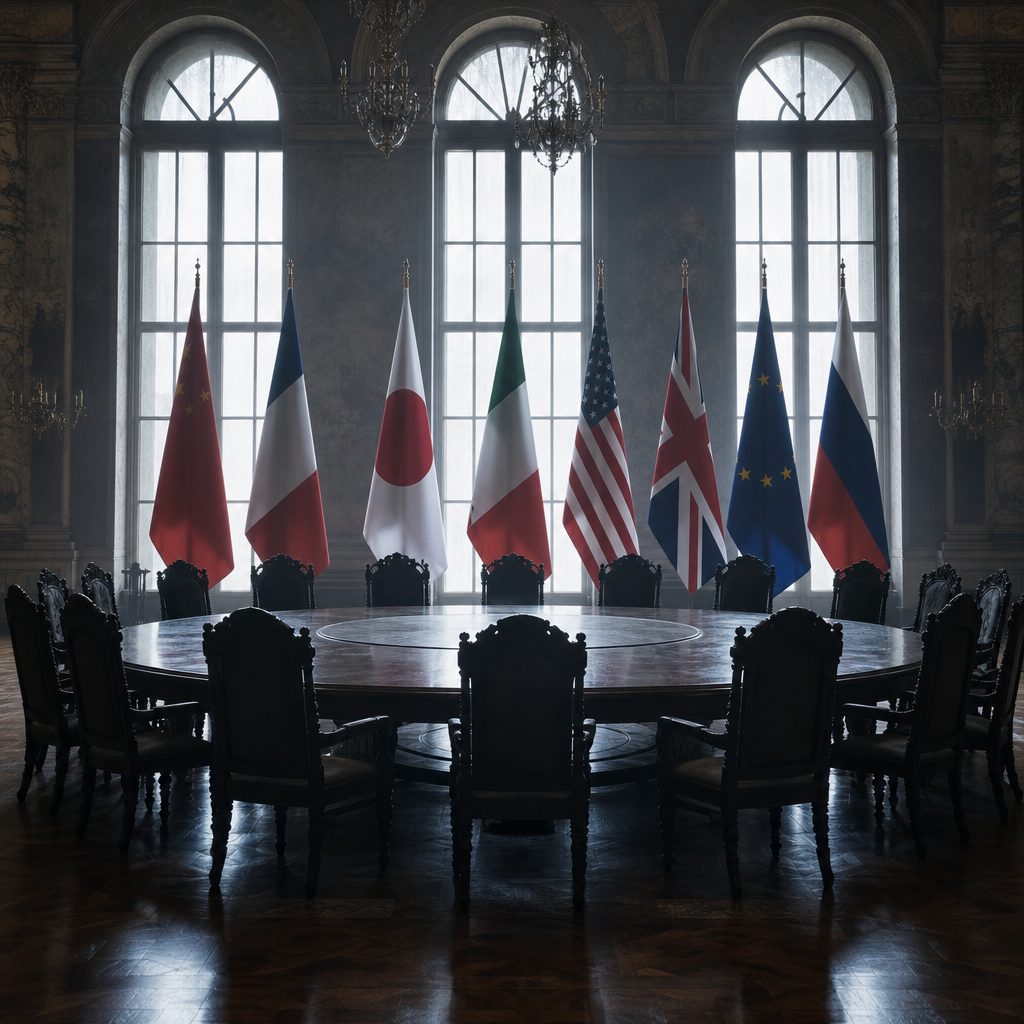
The machinery of great-power negotiation is quieter than it has been in a generation.
For most of the past three decades, the day-to-day business of diplomacy between the world's most powerful states ran on a set of unglamorous but reliable habits. Foreign ministers met on the sidelines of summits. Ambassadors kept lines open even when their governments were shouting at one another in public. Working groups on arms control, trade and climate ground forward regardless of the political weather. That quiet machinery, more than any single treaty, is what kept rivalry from tipping into rupture. Today, much of it has fallen silent.
The change is not that the great powers have stopped talking entirely. It is that the talking has become thinner, more scripted and far more performative. Meetings still happen, but they increasingly produce communiqués rather than compromises. Back-channels that once carried real signals have narrowed or closed. And the shared assumption that underpinned the whole system — that even bitter rivals had an interest in managing their disputes — can no longer be taken for granted.
From management to posturing
Diplomacy, at its most basic, is the art of managing disagreement without resorting to force. For that to work, both sides have to believe the other is negotiating in good faith and that an agreement, once struck, will hold. Over the past several years, that belief has eroded on multiple fronts at once. Sanctions imposed and then tightened, deals signed and then abandoned, and promises made in one administration and discarded by the next have all chipped away at the credibility that makes bargaining possible.
The result is a diplomacy of posture rather than substance. Leaders increasingly speak past one another to domestic audiences, treating summits as stages for demonstrating toughness rather than venues for reaching accommodation. A meeting that ends without a walkout is now sometimes counted as a success. That is a remarkably low bar, and it reflects how far expectations have fallen.
When rivals stop believing that agreements will be honoured, they stop investing in the patient work of reaching them.
This shift has practical consequences. Arms-control frameworks that took decades to build have lapsed or frozen, removing the transparency that once reassured all sides about each other's intentions. Crisis-communication links designed to prevent accidental escalation are used less and trusted less. And the technical cooperation that quietly resolved hundreds of small disputes every year — over shipping lanes, airspace, fisheries, financial rules — has slowed as the political relationships that authorised it have soured.
The fragmentation of the table
Alongside the cooling of relations between individual powers, the very structure of international negotiation is fragmenting. For decades, a handful of forums did most of the heavy lifting. Now those forums are increasingly gridlocked, and states are routing around them, forming smaller coalitions of the willing and cutting bilateral deals that serve immediate interests rather than broad rules.
On paper, this looks like flexibility. In practice, it tends to produce a patchwork of overlapping, sometimes contradictory arrangements that are harder to enforce and easier to abandon. A world of many small tables is not necessarily more cooperative than a world of a few large ones; it is often simply more confusing, with more opportunities for miscalculation and fewer shared reference points when a crisis hits.
Fragmentation also rewards those who benefit from the absence of rules. When there is no agreed framework governing a domain — whether it is cyberspace, critical minerals or the militarisation of new technologies — the fastest-moving and least constrained actors set the de facto standards. That dynamic pushes even reluctant states toward more assertive behaviour, for fear of being left behind or boxed in.
Why the machinery broke down
It would be too simple to blame any single leader or event. The erosion of great-power diplomacy has deeper roots. Three overlapping trends stand out.
Domestic politics has crowded out foreign policy
In many major states, the domestic audience has become the primary audience for foreign policy. Concessions abroad are portrayed as weakness at home, so leaders have strong incentives to appear immovable. Diplomacy, which requires the ability to give a little in order to get a little, becomes politically costly. The space for quiet compromise shrinks in direct proportion to the intensity of the domestic spotlight.
Trust has become a depleted resource
Every abandoned agreement makes the next one harder to reach, because it teaches negotiators that commitments are provisional. Over time, this creates a vicious cycle: low trust produces thinner deals, thinner deals deliver less, and the disappointing results further erode trust. Rebuilding that trust is slow, painstaking work — and it is precisely the kind of work that today's fragmented, short-horizon politics discourages.
The underlying balance of power is shifting
Periods of rapid change in relative power are historically the most dangerous for diplomacy. Rising states want the rules rewritten to reflect their new weight; established states want to preserve arrangements that favour them. When neither side is confident about where the balance will settle, both are tempted to test it rather than negotiate over it. That testing is what much of today's posturing amounts to.
What replaces routine diplomacy
Nature abhors a vacuum, and so does international politics. As formal diplomacy thins, other mechanisms rush in to fill the gap — not all of them reassuring. Economic statecraft has become the tool of first resort, with tariffs, sanctions, export controls and investment screening standing in for the negotiations that once managed disputes. These instruments are powerful, but they are blunt, and they tend to harden positions rather than soften them.
Signalling through military posture is also on the rise. Exercises, deployments and shows of force are increasingly used to communicate resolve when words are distrusted. The problem is obvious: military signalling is far more dangerous than verbal signalling, because it can be misread, and because the margin for error is thin. A great deal of twentieth-century diplomacy was devoted precisely to reducing reliance on such signals. Their return marks a real regression.
The tools filling the space left by diplomacy — sanctions, deployments, ultimatums — are the very tools diplomacy was invented to make unnecessary.
There are, however, some more hopeful substitutes. Track-two dialogues involving former officials, academics and business leaders have taken on new importance, keeping channels of understanding open when official ones close. Regional organisations have in some cases stepped up to manage disputes that the great powers cannot or will not address. And on issues where interests genuinely align — pandemic preparedness, certain aspects of financial stability, the safety of shared infrastructure — narrow, technical cooperation sometimes survives even amid broad political hostility.
The year ahead
None of this means a major conflict is inevitable. The great powers still share an overriding interest in avoiding direct war, and that interest continues to exert a powerful stabilising pull. But the buffer that once absorbed shocks — the dense web of routine contacts, working groups and back-channels — is thinner than it has been in a generation. That makes the system more brittle, and it means that crises which might once have been contained quietly now carry a higher risk of spiralling.
The task for the year ahead is unglamorous but urgent: to rebuild, piece by piece, the habits of communication that keep rivalry from becoming rupture. That means restoring crisis-communication links, reviving even modest arms-control transparency, and protecting the technical cooperation that survives from being swept away by political anger. It means, above all, resisting the temptation to treat every negotiation as a test of strength rather than a search for a workable arrangement.
Diplomacy has never been about affection between rivals. It has always been a cold, practical calculation that talking is cheaper than fighting. The danger of the current moment is not that leaders have stopped believing in friendship between great powers — they never did. It is that they are beginning to doubt whether talking is worth the trouble at all. Restoring that basic conviction is the quiet, essential work of the years ahead.