As Conflicts Multiply, the World's Borders Are Straining Again
Record displacement is testing the limits of asylum systems and reshaping domestic politics far from the front lines. A humanitarian and political reckoning.
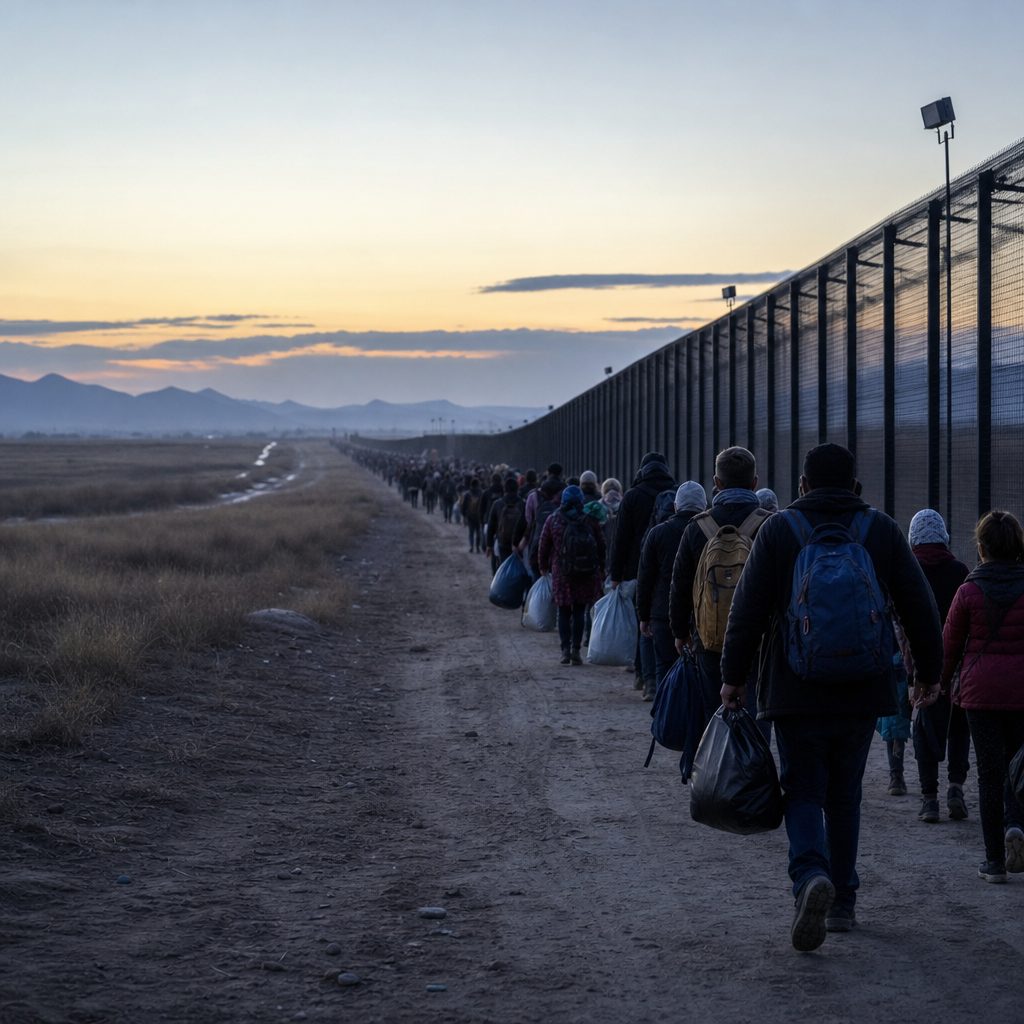
Displacement driven by conflict is testing borders far from the fighting.
Every war produces refugees, and the world is fighting more wars. As conflicts multiply and old ceasefires unravel, the number of people forced from their homes has climbed to levels not seen in generations. Behind the abstract statistics lies a human reality of families uprooted, communities scattered and lives suspended in uncertainty. But the consequences do not stop at the borders of the countries in conflict. Displacement radiates outward, straining neighbouring states, testing distant asylum systems, and reshaping the domestic politics of nations far from any front line.
The relationship between conflict and displacement is direct and unforgiving. When fighting makes home unlivable, people leave — first for the nearest safe place, often within their own country or just across a border, and then, if safety proves elusive, farther afield. Most displaced people never travel far; they remain close to home, hoping to return. But when conflicts drag on for years, that hope fades, and the pressure to seek a durable future elsewhere grows. The current wave of displacement is not a single event but the accumulated result of many conflicts, some new and some reheated, all producing refugees at once.
The neighbours bear the burden
It is a persistent misconception that displaced people flow primarily toward the world's wealthiest nations. In reality, the overwhelming majority are hosted by countries neighbouring the conflicts that produced them — often states with limited resources of their own. These host countries absorb enormous strains: on housing, on schools, on health systems, on labour markets and on social cohesion. They do so frequently with inadequate international support, and the resentment this can breed is a source of instability in its own right.
The generosity of these frontline host states is one of the great under-reported facts of international affairs. It is also fragile. When support fails to arrive and burdens mount, host governments face domestic pressure to close their borders, restrict rights or push people back. Each such decision sends ripples through the system, redirecting flows and shifting the strain elsewhere. The stability of the entire displacement system depends on the willingness of a handful of hard-pressed states to keep their doors open — a willingness that cannot be taken for granted indefinitely.
Most of the world's displaced never reach a wealthy nation. They are sheltered by poorer neighbours whose generosity is real but not limitless.
Asylum systems under pressure
For those who do travel farther, the asylum systems of destination countries have become flashpoints. These systems were designed for a different scale and a different era, and many are struggling to cope. Backlogs stretch into years. Facilities are overcrowded. The legal frameworks that govern who qualifies for protection are contested and increasingly politicised. The result is a process that often satisfies no one: too slow and uncertain for those seeking protection, too permeable in the eyes of those who want tighter control.
The strain on asylum systems is not merely administrative; it is political. The perceived inability of governments to manage their borders has become one of the most potent issues in the domestic politics of many nations. It cuts across traditional divides, mobilises voters, and reshapes party systems. Leaders who are seen to lose control of migration pay a steep political price, which creates powerful incentives for tough measures — measures that may address public anxiety without solving the underlying problem.
Politics far from the front line
Perhaps the most striking feature of the current moment is how deeply conflict-driven displacement is reshaping the politics of countries that are themselves at peace. Migration has become a defining issue in national elections, a fault line in domestic debate, and a lever that shapes everything from welfare policy to foreign relations. Wars fought in distant regions echo in the politics of capitals thousands of kilometres away, as publics grapple with the arrival of people fleeing violence they did not cause.
This dynamic creates a troubling feedback loop. As migration becomes politically toxic, governments grow reluctant to accept refugees, which increases the burden on frontline states, which raises the risk that those states will buckle, which in turn produces larger and more chaotic movements. Meanwhile, the political energy consumed by the migration debate can crowd out attention to the conflicts that generate displacement in the first place. Treating the symptom while ignoring the cause is a recipe for a permanent crisis.
The search for durable solutions
There are, in principle, three durable solutions to displacement: return home when it becomes safe, integration into the host country, or resettlement to a third country. All three are becoming harder. Return depends on conflicts actually ending, which fewer of them do. Integration requires host societies willing and able to absorb newcomers, which political pressures increasingly discourage. And resettlement, the most orderly path, has shrunk as destination countries have grown more restrictive. With all three routes narrowing, more and more displaced people find themselves in a prolonged limbo — neither able to go home nor to build a stable future elsewhere.
Addressing this requires action on two fronts at once. In the short term, it means supporting the frontline states that host most of the world's displaced, so that their generosity does not collapse under the weight of neglect. In the longer term, it means confronting the conflicts that drive displacement in the first place — the wars, the persecution and the state collapse that force people to flee. Neither task is easy, and both are made harder by the very fragmentation of international cooperation that this era has produced.
A test of the international order
Displacement is, in a sense, the human face of the wider disorder in world affairs. Every strained border, every overwhelmed camp, every contentious asylum debate traces back to a failure to prevent or resolve conflict. The scale of the current crisis is a measure of how many of those failures have accumulated, and how weak the mechanisms for addressing them have become.
Every strained border is the downstream consequence of an upstream failure to keep the peace.
How the world responds will say a great deal about its character. A response built on shared responsibility, adequate support for host states, and a serious effort to end the conflicts driving displacement would ease the strain and uphold the principle that people fleeing violence deserve protection. A response built on closed borders, shifted burdens and neglect would deepen the crisis and corrode that principle. The choice is being made now, in a thousand decisions large and small, at borders and in capitals around the world. Its consequences will be felt for a generation.