Trump Grants Kyiv Licence to Produce Patriot Interceptors at NATO Summit in Türkiye
Washington's decision to let Ukraine manufacture the coveted air-defence missiles on its own soil arrived days after the heaviest aerial barrage of the war on Kyiv. It could quietly become one of the most consequential moves of 2026.
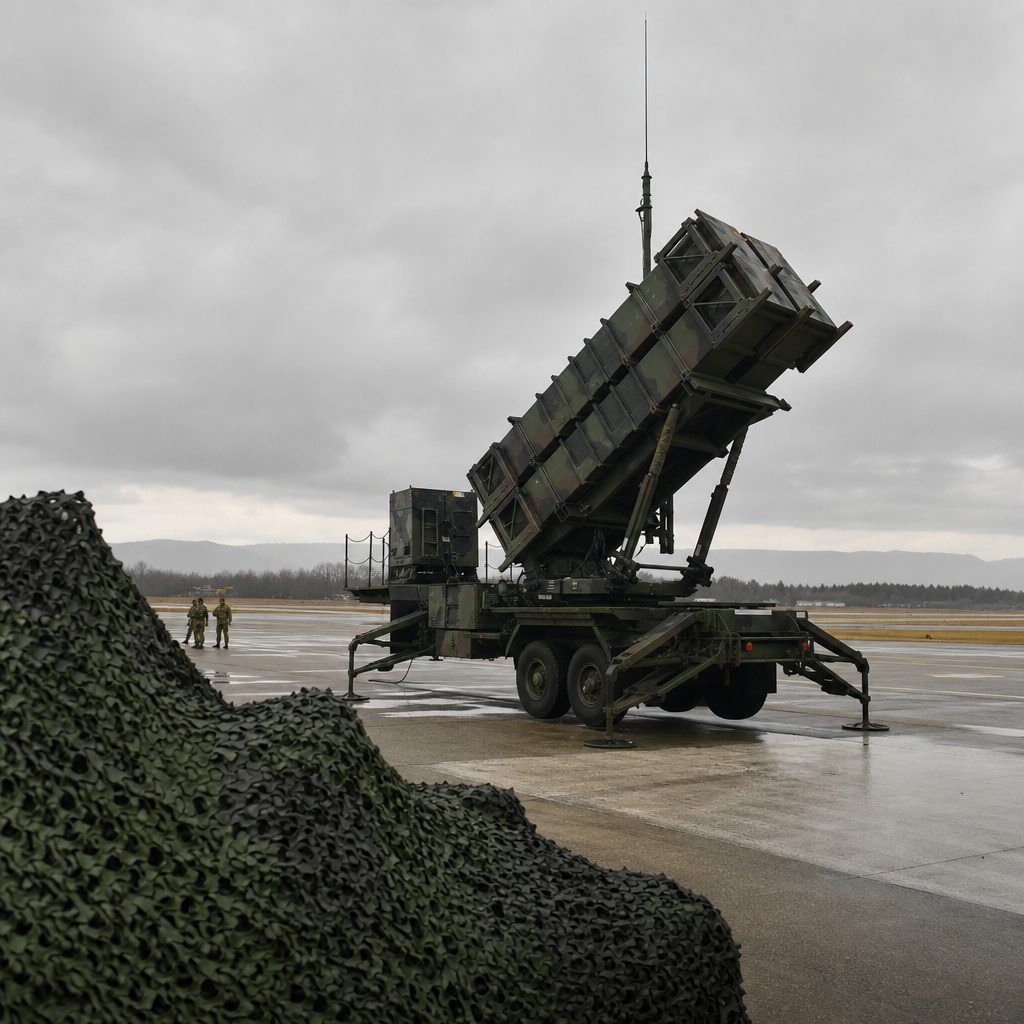
A Patriot launcher on standby. For three years Ukraine has depended on a trickle of imported interceptors; that arithmetic may now change.
For three years, the single most important number in Ukraine's air war has not been the number of missiles Russia fires, but the number of Patriot interceptors Ukraine has left to shoot them down. Every launcher, every reload, every replacement round has had to be negotiated, shipped and rationed across an alliance that was never designed to keep a full-scale interceptor war supplied indefinitely. On the sidelines of the NATO summit in Türkiye this week, that arithmetic shifted. The United States, according to officials briefed on the talks, agreed to grant Ukraine a licence to produce Patriot interceptor missiles domestically — a concession Kyiv has sought since the earliest months of the invasion.
The announcement was deliberately understated, folded into a broader package of summit commitments and delivered without the theatrics that usually accompany major arms decisions. But its significance is hard to overstate. A production licence is not a one-off shipment that can be counted, celebrated and then exhausted. It is a standing capability — the difference between being handed fish and being handed a fishing fleet. If it holds, and if the industrial machinery behind it can be built at scale, it changes the fundamental logic of Russia's aerial campaign.
Why the decision came now
The timing was not accidental. It followed one of the war's darkest weeks in the skies over Ukraine. On July 8, Russia launched what Ukrainian officials described as the single largest combined air assault of the conflict: a barrage of 68 missiles and 351 drones aimed at Kyiv and surrounding regions over the course of a single night. At least 27 people were killed. The attack overwhelmed sections of the capital's layered defences and left rescue crews working through rubble into the following afternoon.
President Volodymyr Zelenskyy, addressing the nation afterwards, framed the barrage in stark terms. "This war will be won or lost in the skies," he said — a phrase that has since been repeated across Ukrainian media as shorthand for a strategic truth the country has learned at brutal cost. The message to Ukraine's partners was unambiguous: shipments alone, however generous, cannot keep pace with an adversary willing to fire hundreds of drones and dozens of missiles in a single night. Only domestic production, at industrial scale, offers a way out of the rationing trap.
"This war will be won or lost in the skies." — President Volodymyr Zelenskyy, following the July 8 barrage on Kyiv
What a production licence actually means
It is worth being precise about what has, and has not, been agreed. A licence to produce Patriot interceptors does not mean Ukrainian factories will begin rolling out finished missiles next month. The Patriot system is among the most technically demanding weapons in the Western arsenal, drawing on seeker technology, propulsion, guidance electronics and quality-control standards that took decades to develop. Establishing domestic production is a project measured in months and years, not weeks, and it will depend heavily on the transfer of components, tooling and expertise.
What the licence changes is the ceiling. For the first time, Ukraine has permission to build toward a self-sustaining supply rather than remaining a perpetual recipient. It allows Kyiv to plan around its own industrial base, to co-produce with European partners, and to escape the political bottleneck in which every reload has to survive a fresh round of debate in allied capitals. In a war of attrition fought largely in the air, the side that can replenish its defences faster than the other can deplete them holds a decisive advantage. This is Ukraine's bid to close that gap.
The drone problem behind the headline
The record barrage on Kyiv also exposed a mismatch that has come to define the modern air war: the economics of attack versus defence. Russia's long-range strike drones are comparatively cheap, produced in large numbers, and designed to be expendable. A Patriot interceptor, by contrast, is an extraordinarily sophisticated and expensive round. Firing one of the West's most advanced missiles to destroy a low-cost drone is a trade Ukraine cannot afford to make indefinitely, no matter how large the interceptor stockpile becomes.
This is why the production licence, significant as it is, addresses only part of the problem. Ukrainian and allied planners increasingly speak of a layered approach: reserving Patriots for the high-end ballistic and cruise-missile threats they were built to defeat, while pushing cheaper systems — gun-based defences, electronic warfare, and a new generation of low-cost interceptor drones — to the front of the line against the drone swarms. Domestic Patriot production and cheap counter-drone capacity are not competing strategies; they are two halves of the same answer.
A war increasingly fought by networks, not lines
Beneath the headline decisions, the character of the war itself continues to change. The front is no longer defined primarily by trenches and armoured thrusts, but by a dense, constantly updating web of sensors and strike drones. Reconnaissance drones loiter over the contact line, feeding coordinates to strike systems that can hit a target within minutes of its being spotted. The result is a battlefield where movement in daylight has become extraordinarily dangerous and where the advantage flows to whichever side can see, decide and strike fastest.
Both militaries have adapted to this network-centric reality with striking speed. Software updates now matter alongside artillery calibre; the ability to integrate a new drone type or jam a new frequency can shift the balance along a stretch of front more quickly than the arrival of new heavy weapons. It is a mode of warfare that rewards improvisation and industrial adaptability — precisely the qualities a domestic production licence is meant to reinforce.
The strikes reaching deep into Russia
The air war is not one-directional. Ukraine has expanded its own long-range strike campaign against military and energy targets far inside Russian territory, including reported strikes on refining infrastructure such as the facility at Omsk, deep in Siberia. These operations serve a dual purpose: degrading the logistics and revenue that sustain Russia's war machine, and demonstrating to a domestic audience that the cost of the war can be carried back across the border. Each such strike also complicates Moscow's air-defence calculus, forcing it to spread resources across a vast interior it once considered safe.
The economics of the air war are brutally simple: the side that can replace its defences faster than the other can exhaust them will hold the sky.
What to watch next
The production licence is a commitment, not yet a capability, and several questions will determine whether it becomes the turning point Kyiv hopes for. The first is speed: how quickly can components, tooling and technical support actually flow, and how fast can Ukrainian and European industry stand up production lines resilient enough to survive Russian targeting? The second is durability: agreements made at one summit can be revised at the next, and Ukraine's planners will be acutely aware that a licence is only as good as the political will sustaining it.
The third question is the largest. Even a fully self-sufficient Patriot supply cannot, on its own, end a war. It can deny Russia the ability to win through air superiority; it can keep Ukrainian cities and infrastructure standing; it can buy time. But time for what remains the unanswered strategic question hanging over the entire conflict. For now, the significance of the Türkiye summit lies in something narrower and more immediate: after three years of counting interceptors one by one, Ukraine has finally won the right to build its own — and in a war being decided in the skies, that is no small thing.