The Taiwan Strait Is the World's Most Dangerous Flashpoint — and It Is Getting Tenser
Record military incursions, near-daily grey-zone pressure and a global economy that runs on Taiwanese chips have turned a 180-kilometre channel into the place where the great-power rivalry could turn hot.
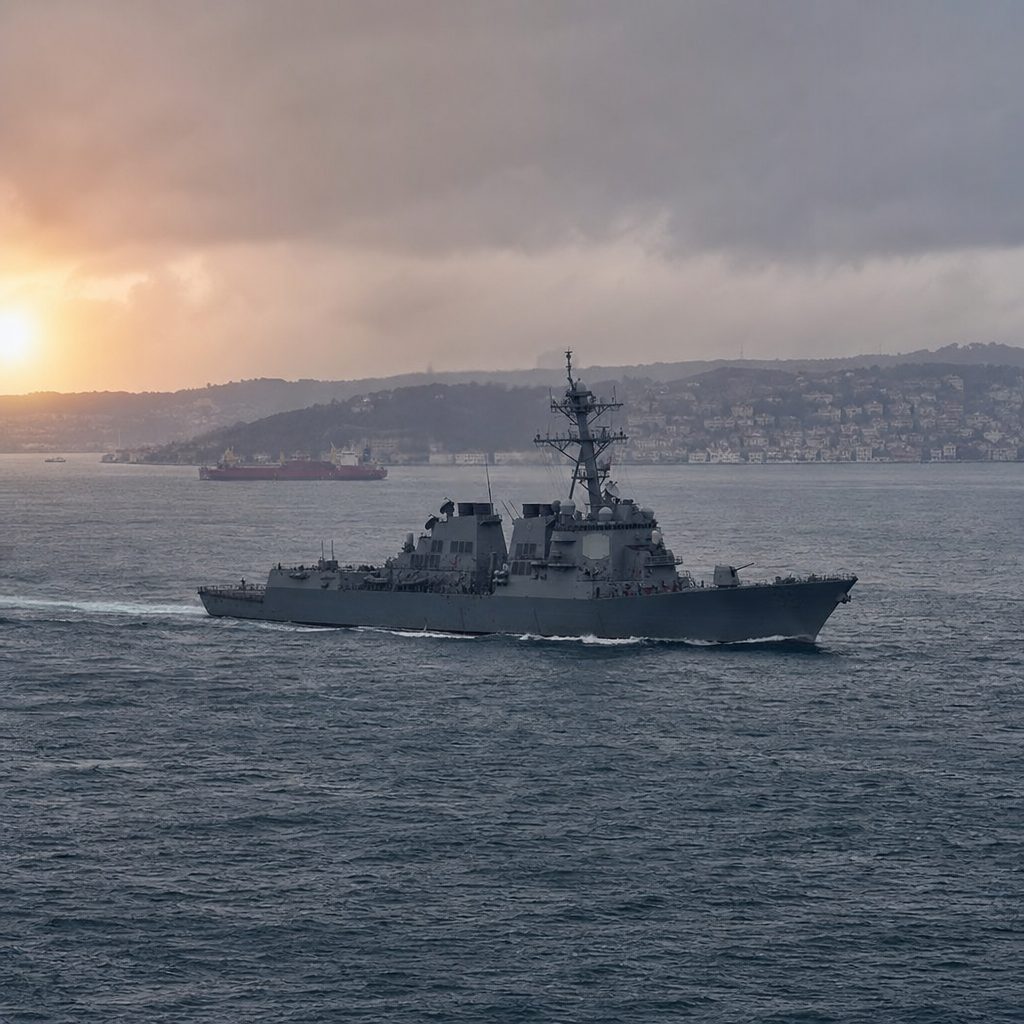
Warships and commercial traffic share the same narrow waters. A miscalculation here would reverberate through the entire world economy.
Of all the places where the twenty-first century's great-power rivalry might tip from tension into open conflict, none carries higher stakes than a strip of water roughly 180 kilometres wide separating Taiwan from mainland China. The Taiwan Strait has long been described as the world's most dangerous flashpoint, and the phrase has become so familiar that it risks losing its force. It should not. The combination of factors converging on this narrow channel — military, political and economic — is unlike anything else in the international system, and the pressure has been building, not easing.
What makes the strait so combustible is not any single dispute but the way three separate fault lines run directly through it. There is the unresolved political question of Taiwan's status, over which Beijing and Taipei hold irreconcilable positions. There is the intensifying military competition between the world's two largest powers, for whom Taiwan has become the central test of resolve. And there is the strait's extraordinary economic importance, which means that any conflict here would inflict damage far beyond the region. Each of these alone would be dangerous. Together, they make the strait uniquely so.
The pressure that never lets up
The most visible sign of rising tension is military. For several years, incursions by aircraft and naval vessels into the airspace and waters around Taiwan have climbed steadily, setting new records with grim regularity. What was once an occasional show of displeasure has become a near-constant presence — a campaign of pressure designed to normalise a military footprint close to the island, wear down its defenders, and probe responses without crossing the threshold into open attack.
This is the essence of "grey-zone" pressure: coercion that stays deliberately below the level that would trigger a decisive response. Large-scale exercises rehearse blockade and encirclement. Aircraft cross the median line that once served as an informal buffer. Coast guard and maritime militia vessels assert presence in contested waters. None of it is war, but all of it erodes the status quo, shifting the baseline of what is considered normal and testing where the real red lines lie. The danger is not only that one of these encounters could escalate by accident, but that the cumulative pressure could achieve, incrementally, what a single dramatic move could not.
Grey-zone pressure works by moving the line a little at a time — until one day the old normal is gone, and no one can quite say when it changed.
Why the whole world has a stake
What sets the Taiwan Strait apart from other flashpoints is that a conflict there would not be a distant regional tragedy; it would be a global economic catastrophe. The reason can be summed up in one word: chips. Taiwan is home to the overwhelming majority of the world's most advanced semiconductor manufacturing capacity — the tiny, extraordinarily complex components that power everything from smartphones and cars to data centres, medical devices and advanced weapons. There is no ready substitute for this capacity, and there could not be one for years.
A serious conflict in the strait — whether an outright blockade or actual fighting — would sever or cripple that supply almost overnight. The consequences would cascade through virtually every advanced industry on earth. Car factories would halt for want of chips, as they did during far milder shortages. Consumer electronics would vanish from shelves. The cost would run into the trillions and would be borne not only by the combatants but by every economy that depends on modern technology, which is to say all of them. The strait is a chokepoint not just for shipping but for the entire technological foundation of the modern world.
The shipping dimension
Beyond semiconductors, the strait is one of the busiest shipping lanes on the planet. A vast share of global trade passes through or near it, and much of the maritime traffic serving the world's most dynamic economies threads these waters. A blockade, or even sustained instability, would force shipping to reroute, drive up insurance and freight costs, and snarl supply chains that are still fragile from years of disruption. As with the Strait of Hormuz and oil, the strait's power lies partly in the fact that there is no easy way around it.
Why deterrence is so delicate
For decades, an uneasy peace across the strait rested on a carefully maintained ambiguity — a set of understandings that allowed all sides to avoid forcing the question. That ambiguity is now under strain from several directions at once. The military balance has shifted, changing everyone's calculations about what is possible and what is affordable. Domestic politics on all sides has hardened, reducing the room for the quiet compromises that once kept the peace. And the broader deterioration in great-power relations has stripped away much of the trust that made restraint credible.
The result is a situation in which deterrence depends on extraordinarily fine judgements. Each side must convince the others that it is resolute enough to make aggression too costly, without being so provocative as to trigger the very conflict it seeks to prevent. It is a balance that has held for a long time, but it is being tested more severely, and more often, than at any point in living memory. And the margin for miscalculation — a collision at sea, a misread exercise, an incident that spirals — is uncomfortably thin.
The peace across the strait has always rested on ambiguity. The danger of this moment is that ambiguity is being replaced by certainty on every side but one — the outcome.
What to watch
There is no reliable way to predict when, or whether, tension in the strait will tip into crisis; anyone claiming certainty is guessing. But there are indicators worth watching. The tempo and scale of military activity is one: a shift from routine pressure to sustained, large-scale operations would signal a change in intent. The state of communication channels is another; the quiet mechanisms that allow rivals to manage incidents are precisely what prevent an accident from becoming a war. And the wider trajectory of great-power relations matters, because the strait does not exist in isolation — it is the sharpest edge of a much broader contest.
For now, the most important thing to understand about the Taiwan Strait is the scale of what is at stake. This is not a peripheral dispute over a distant island. It is a place where the world's two most powerful states confront each other directly, where the foundations of the global technology economy sit within artillery range, and where a single miscalculation could impose costs measured not in headlines but in trillions of dollars and untold human consequences. The strait has stayed peaceful for a long time. Keeping it that way is one of the central challenges of the age.