Gridlock at the Top: Can Global Institutions Still Keep the Peace?
Vetoes, walkouts and stalled resolutions have left the world's peacekeeping bodies struggling to respond. Inside the crisis of multilateralism.
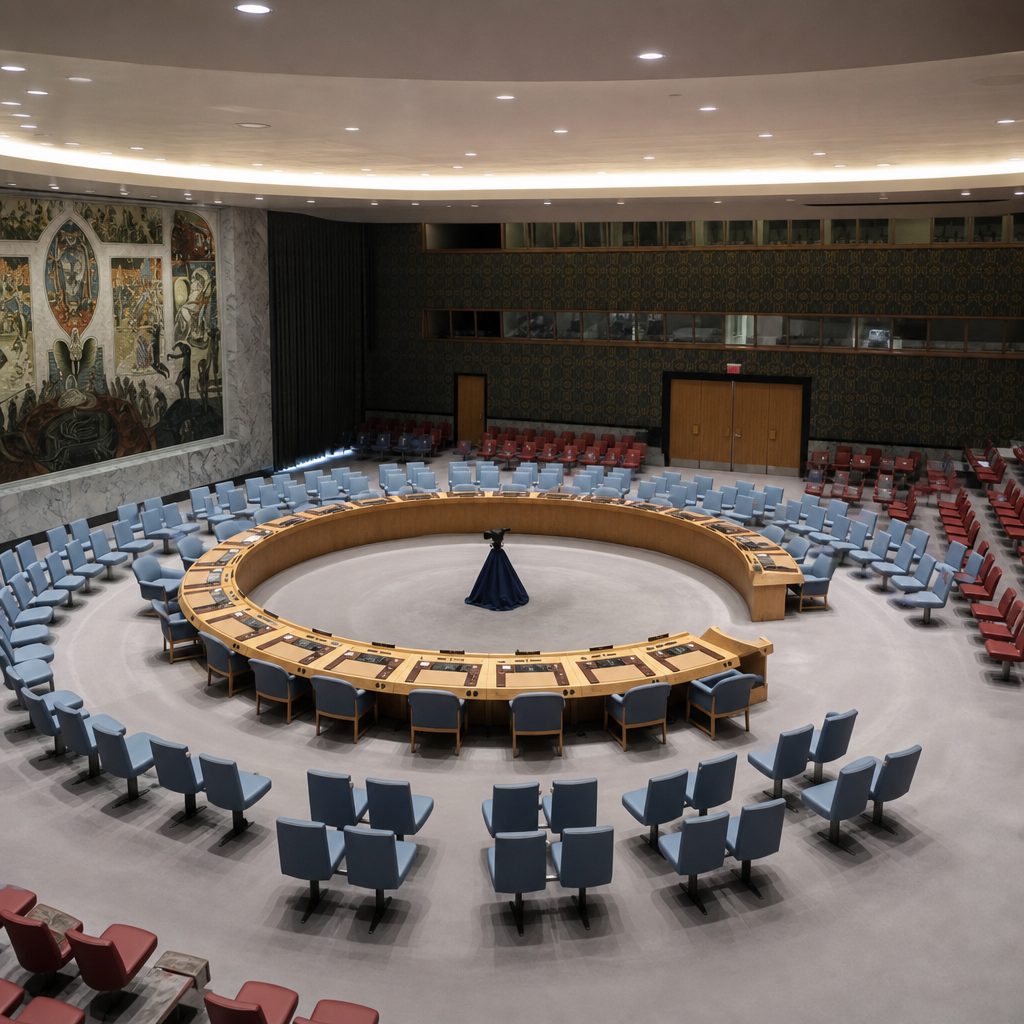
The chambers built to prevent war are increasingly unable to act.
The institutions built after the last global catastrophe were designed with a single, sober purpose: to prevent the next one. They were meant to give states a place to air grievances short of war, to coordinate collective responses to aggression, and to lend legitimacy to the difficult work of keeping the peace. For decades, imperfect as they were, they served that purpose well enough. Today, the most important of them are increasingly paralysed — unable to act decisively at precisely the moments they were built for.
The symptoms are familiar to anyone who follows international affairs. Resolutions are drafted and then vetoed. Debates end in walkouts rather than agreements. Investigations are blocked, mandates go unrenewed, and urgent crises produce statements of concern rather than coordinated action. The machinery still turns, but it produces less and less. The question is no longer whether the system is strained; it is whether it can still perform its core function of keeping the peace.
The veto and its discontents
At the heart of the paralysis lies a design feature that was, in its time, a deliberate compromise. The most powerful states were given a special status — including, crucially, the ability to block collective action. The reasoning was pragmatic: an institution that tried to coerce the great powers would simply be ignored or destroyed, so it was better to give them a stake in the system by guaranteeing they could never be overruled on matters they considered vital. This bargain kept the great powers inside the tent.
The cost of that bargain is now painfully visible. When the great powers are broadly aligned, the system can act. When they are at odds — as they increasingly are — any one of them can bring collective action to a halt. The result is a body that is most effective when it is least needed and least effective when it is needed most. In an era of sharpening rivalry, the veto has become less a safety valve than a permanent brake.
The system was built to be effective when the great powers agree. Its tragedy is that it is needed most precisely when they do not.
Legitimacy under strain
Paralysis at the top does more than block specific actions; it corrodes the legitimacy of the whole system. When the institutions charged with upholding international rules are seen to apply them selectively — acting forcefully in some cases and standing aside in others, depending on which great power's interests are at stake — their moral authority erodes. States and publics begin to view the rules as a tool of the powerful rather than a genuine common framework, and their willingness to abide by them weakens accordingly.
This erosion of legitimacy is self-reinforcing. The less credible the institutions appear, the more states feel justified in ignoring or working around them, which further undermines their credibility. Over time, the shared sense that there are rules everyone is expected to follow — the intangible asset that made the system valuable in the first place — begins to dissolve. Rebuilding it is far harder than preserving it, and the current trajectory is toward its slow depletion.
Peacekeeping in a harder world
The practical work of keeping the peace has become correspondingly harder. Peacekeeping missions depend on a clear mandate, adequate resources and the consent of the parties to a conflict. All three are harder to secure in a divided system. Mandates become vaguer as they are watered down to win approval; resources shrink as contributing states grow reluctant; and consent evaporates as the parties to conflicts calculate that the international community is too divided to enforce anything.
The consequence is missions that are asked to do more with less, in more dangerous environments, with weaker political backing. Some struggle to protect the very civilians they are deployed to shield. Others become semi-permanent fixtures, freezing conflicts without resolving them, because the political agreement needed to end a war cannot be reached at the top. Peacekeeping was never a substitute for peacemaking, but in a gridlocked system it is increasingly asked to be exactly that.
The search for alternatives
Faced with paralysis at the centre, states are improvising. Some crises are now handled by regional organisations, which are closer to the conflicts and sometimes better placed to act. Others are managed by ad hoc coalitions of concerned states, assembled outside the formal system for a specific purpose and disbanded afterward. These workarounds can be effective, but they lack the universal legitimacy of the institutions they bypass, and they risk fragmenting the response to global problems into a patchwork of regional and coalition efforts with no common standard.
There are also perennial proposals to reform the system itself — to expand membership of its key bodies, to limit the use of the veto in cases of mass atrocity, or to strengthen the mechanisms that hold states accountable. Such reforms are widely discussed and rarely enacted, precisely because the states with the power to block change are the ones whose privileges reform would curtail. The very gridlock that makes reform necessary also makes it nearly impossible.
What is at stake
It would be easy to dismiss the paralysis of global institutions as a distant, technical matter. It is not. These bodies, for all their flaws, embody a hard-won idea: that even sovereign states, jealous of their independence, share an interest in a common framework for managing their disputes. When that framework fails, states fall back on self-help — on alliances, arms and unilateral action — which is exactly the dynamic the institutions were built to escape.
When the common framework fails, states fall back on self-help. That is precisely the world the institutions were built to prevent.
The current gridlock does not mean the institutions will disappear. They are likely to endure, diminished, as forums for debate and as providers of essential technical functions even when their political machinery is jammed. But the erosion of their ability to keep the peace is a serious loss, and it is happening at the worst possible time — as rivalries sharpen and conflicts multiply. Whether the world can revive these institutions, or build credible alternatives, may prove to be one of the defining questions of the coming decade. The alternative, a return to a world in which the strong do as they will and the weak suffer what they must, is precisely what the founders of the modern system set out to avoid.